Wednesday, November 21, 2012

Annual 'Copter Ride

Dean and the Squirrel doing GPS runs
Finally got a still morning, and AeroWork's Dean Lithgow was on the ball, turning up to do the annual gorse run in the Squirrel, a nice smooth machine.
Its a long shot from early days of Alexander Helicopter's Bell, (aka the ones you see in Mash *** re-runs), piloted by Rex Sherlock. It was quite a novelty in those days, I got the show-around-the-place rides as a school kid, one time hooking the skid under a cast ewe to flip her on her feet, and another being heroically delivered to school.
The old man used to do it but he got put off the time they were puttering up a gully when the power board high tension lines suddenly appeared in front of the perspex bubble, this was in the days when the industry didnt think about those things. Rex dropped the chopper 12' in a fraction of a second, and went through underneath, but the impression was significant enough, the old man delegated me to do the spotting from then on.
Re-loading
Rex further expounded about the time he was doing a job in a remote part of the Waitotara Valley, when he got a skid entangled in the telephone wires beside the road, and try as he might backing up and dropping and lifting, the wires wouldnt let go of him.
As extreme good fortune had it, the P&T, on a rare occasion, happened to be doing line maintenance less than a mile away, and on hearing the chopper working so close the men decided to go and spectate. Lucky they still had their ladders on the truck.
Back to the gorse, last years spray-up was done in Jan, a bit late in my book to catch the best of the growing fronds, at 7 litres Eliminate (Ravensdown's Grazon equivalent) per ha. While the kill wasnt 100% I was happy enough with the foot or so knock-back in bush height. I was also amenable to Dean's suggestion to do 8 litres on some of the heaviest this time, but I think being on the button with the November timing will see it brown off pretty good.

Tuesday, November 20, 2012

Ram Hoggets Eye-muscle Scan

Steve came in recently to do the annual eye-muscle scan on the ram hoggets, which I start into selling to the commercial flock market late Jan/Feb 2013. Measuring muscularity is an indicator of meat yield and heritability of the trait is quite high.
I use Ian Walsh's Falkirk scanning and indexing system, Steve, his local area agent, comes over from Taranaki to do mine.
The results are always something you look forward to, but this year marks the first progeny crop of a sire ram I like a lot, (we breeders all have our from-time-to-time favourites). This year its Waione 75/08, a bigger type of sheep with a good thick carcase. He and his twin brother have dominated DPG growth index from their hgt days.
Falkirk put out an index summary based on the usual combination of live-weight, eye muscle width and depth, and rib fat depth. It dosent have the sophistication of heritability included as do SIL index values, but at least you know the h2 of around .30 applies equally to all the hgts.
They also do a sire summary, assessing % of progeny falling into 5 progressive grades of excellence.
75/08 heads the bunch with nearly 68% of his progeny falling in the top 2 grades.

Thursday, November 15, 2012

New Arrival

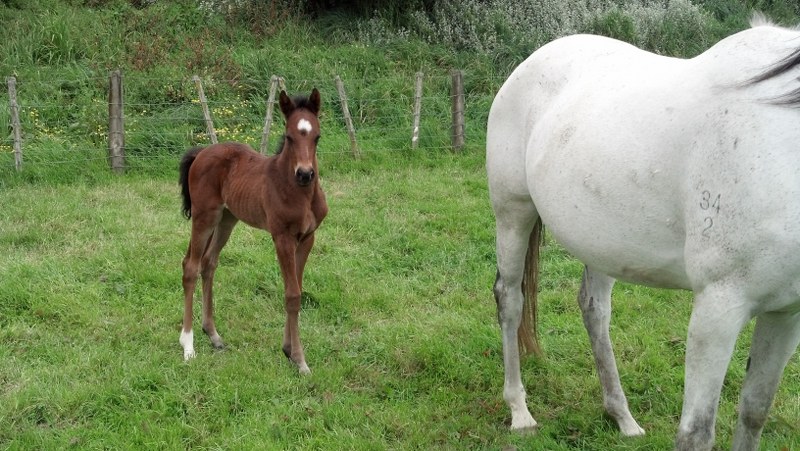
Just one foal this season, born 11th Oct, by Helmsman, from Danske mare, Local Knowledge.
Back in the 2011 breeding season I'd invited Peter Hall to come along to Dalacine Farm taking a look at Indy King, who I was considering putting my own mare to.
I was taken with Helmsman's disposition as we passed his paddock, and with his conformation cover off, and then with his resemblance to Buckpasser, his paternal grandam's sire.
He was a fair performed Group winning horse himself too, over a million in stakes from 6f to a mile and a quarter, started his stud career in USA in 1998, and his US progeny have won over $18m.
Seriously, thats a lot better credential than many of the high priced stallions standing round the country these days. Its a rich pedigree to boot, not a bum line in the 5th remove, Northern Dancer on the top-line, with a 5x5 of War Admiral, and a 4x5 of Princequillo, giving Round Table in the dam's sire-line.
The dam had 9 foals to race for 8 winners, one other group winner beside Helmsman.
Knowing Peter and partners were in a hiatus with Local Knowledge I made an offer on the spot to go 50/50.
So, all year I've nursed this expectation of a mahogany bay Buckpasser look-alike, and was a bit dumbfounded when a little bay filly popped out instead, star, white hind fetlock, which set a memory bank scan in motion....... Danedream....
Back inside after the foal had got its first drink, she did that in short order too, I did a Google on last year's Prix de L'Arc de Triomphe, and bingo, little bay filly, star, white hind fetlock, only we got ours on the side opposite to Danedream's.
Main similarity is the Northern Dancer on top and bottom line, Danedream gets hers by Nijinsky over Danehill mare, our foal gets hers by El Gran Senor over Danehill mare, quite close on the Northern Dancer double.
Frankly, I think ours is a better pedigree with Sound Reason and Sir Tristram chucked in, yielding a double of Round Table 5x7, plus a 4x6 of Buckpasser, and the Northern Dancer 3x5x6.
Here we go...... dream number... whatever, lol

Saturday, October 27, 2012

New Toy: Raven Cruizer

Fitting out a 4 metre 4-wheeler mounted pasture spraying rig with a $4000 GPS guidance might seem like an over-luxury.
And hoo boy, yep, it is.
Previously I've used a foam-marker for those circumstances where poor light or insufficient grass length have made row-tracking difficult or impossible, but not without some angst, namely the foam would most times run out before the tank load did, and worse, the foam track would all have dissipated before you got back to the paddock with the next load.
Add to that, the inconvenience of trying to refill the foam tank with its residue froth trying to climb out while you're trying to add the next charge of foam concentrate, plus the time for loading the extra 20 litres of water... a couple of seasons riding with Sandford's fert-spreader trucks and watching their GPS guidance system operating had me day-dreaming big-time.
So it all came to pass when I stumped up for a Raven Cruizer II unit from Croplands stand at this year's National Field-days.
The white thing on the left is the Helix antenna, accurate to 23cm, its got a strongly magnetised base, plonks stable anywhere metal.
I decided the console should centre mount, reasonably high, fixed out front rather than on the handle-bars, so you can keep a better bead on direction of travel. A lot of tractors have the GPS consoles mounted well off to one side in the cab, which I think would take your eyes off where you're going, unless of course you're doubling the cost of installation opting for auto-steering control as well, but hey, this is a 4-wheeler I'm using here.
The console gets its power from the cigarette-lighter style plug most 4-wheelers have, a simple plug-in.
The unit took ages to establish satellite link, so long I thought something was wrong, went inside to have a sob and a cuppa, and a think about phoning the agents, wandered back out and voila, it was all go!
On initialisation, which was well programmed to be intuitive and I completed with minimal referral to the manual, which itself is appropriately minimal, you set up the swath width and fore and aft and sideways distance from the boom centre, then you're good to go.
You get 4 tracking options, following where you went last time, (which is what I use for round and round), straight lines as in "lands", bent lines, and circles.
There are 3 indicators telling you whether you're on the right track, a line of LED's across the top, green when you're on track, red to the side if you stray; directional arrows in the blue horizontal band showing where you should steer; and the one I settled on for preference, when you line up to your previous track a red path-line appears, and you keep the point of the arrow on the line, a lot more intuitive than the other 2 systems.
Of course, you cant beat visual on your last row, but then you dont always see it, and that's the purpose of this exercise.
The stats in the blue band are pretty good, ground speed in particular for spraying, but the ha meter includes all your turn-outs.
You'll see from the pic I'm leaving a few ta ta's, but that dosen't worry me much, there's enough drift at the boom's extremes to cover it I think, and also given the 23cm accuracy give or take.
By and large, my eye's a lot faster than the GPS, but I might try setting the fore/aft initialise at zero to see what happens.
Very convenient too, when the current load runs out, the system tells you where to resume when you've refilled. Re-booting also happens quickly when you switch on after the refill.
I'll be using the system on the tractor in a month or so's time too, mine's an old one, sans cab, when I do my summer crop direct drilling which I have to do in lands because the drill cant do turns. It'll save me having to get on and off to step out and peg the strike-outs, then pick up the pegs after.
The mounting systems supplied in the box make transfer between vehicles very practicable.
Very happy with this purchase.

Sunday, August 26, 2012

FE - Changing Angle on Breeding for Resistance

This year I've GGT bloodtested all 2th ewes coming into the recorded flock.
I used to do this on a regular basis 10 or so years ago as a better way of screening for FE resistance. I figured that proving a ram by dosing, then mating him to females of unknown resistance status didnt make as much sense as GGT screening both sexes, utilising the best and getting rid of the worst.
I ceased the practice when I started Ramguard testing stud sires. The cost of doing both was a bit of a burden, and there was always the thought that selection on conception rate/reproduction, part of the Coopworth Genetics breeding platform, was also selecting indirectly for resistance anyway, (see table left, ewes carrying higher sub-clinical FE have lower conception rates, data from the Waione flock), so I discontinued.
Its important to note that the GGT values shown in the table were obtained from no particular effort to induce or reflect a challenge. I'm often questioned on the validity of GGT screening like this, but believe me, variation is there, even if you dont see it visually, or register a challenge season. The response might vary from season to season, but the more important observation to my mind is that the "good" animals show no, or very little response by way of their GGT's elevating.
Recent and ongoing DNA research work by Phua and Dodds, AgResearch, Invermay, detailed in the 2011 AAABG Conference Proceedings, adds significantly to understanding the resistance problem, what to do about it in the breeding program, and is why I've resumed the GGT screening.
Sheep cope with sporidesmin in their system three ways:
1- non-absorption from the gut
2- de-toxification by the liver
3- or by the anti-oxidation process.
The researchers have so far found eight "chromosomalities" affecting these processes. They're gene groupings that dont overlap, and may be present, or not present, and in differing states of effectiveness, depending on mutation.
Which suggests the modes of resistance offered by respective flocks might differ.
There's also a suggestion some of them may be X-linked, ie. travel with the female X chromosome.
This latter point interested me, so I had a look at how SIL's FE index, DPX, related to ewe performance in the lambing paddock. In the Waione flock DPX is based not just on Ramguard dosing result, but moreso on the ongoing supply of annual GGT blood-test of all MA and incoming 2th sires, commercial included.

Lambing Group                              Mean Ewe DPX

Barren                                                 -14
Single, survived                                     10
Single, lost                                           -27
Twin, both survived                               -6
Twin, lost one                                         6
Twin, lost both                                     -31
Triplet, all survived                                  1
Triplet, lost one                                    -51

lambed as a hgt                                     20
not lambing as hgt                                  -6

From just one season's data there appears to be a fair relationship between foetal/lamb survival and FE resistance as indicated by DPX. I hope the relationship will repeat this coming lambing.
I suspect the healthier ewes may better safeguard their on-board litter through the last few weeks of gestation.
Phua's research shows an ongoing ability for resistant genes to evolve from continued use of tested sires over ewes of even unknown status, over the last 27 or so years a steady heritability of .38 has shown no sign of abating.
By including incoming 2th ewes GGT I hope to make the flock DPX even more robust.
I'll be able to select the very best DPX sires to use in the breeding program, and drop off the worst females.
Its more than likely I'll discontinue Ramguard dosing, the rams I'm using are invariably passing .6 dosing anyway.

Thursday, August 23, 2012

First Aid

Our industry workplace, the farm, is an environment where accidents, if they happen, can be severe.
Taking a basic first aid course is something I've always wanted to do, and I finally got to last weekend joining with one organised by my local branch of Ulysses Motorcycle Club in conjunction with St John's.
I thought we were in for a fair bit about doing stuff to wounds and bone breaks, but things have moved on over the years, and now its focussed more on securing the accidentee and immediate environment, and preparing for arrival and/or evacuation with the first aid response professionals.
St John have devised an acronym based response guide, DRS,ABC+D

D - danger - scene assess for self, others, patient
R - response - check patient status, call name, squeeze shoulder
S - send for help
A - airway - check for clear, recovery position
B - breathing - check look, listen, feel, if none go to...
C - CPR - compressions/breaths '30:2 no matter who' till pro's arrive
D - defrib - increasingly at hand these days, auto-commands inbuilt

We also covered dealing with choking, bleeding, and bone breaks in the immediate response context.

The St John website has a good summary of the above.
The St John course instructor was excellent, as was the St John training rooms, in fact, edifying to get to appreciate the whole local St John facility.

This week I've increased my regular donations to St John, and to the local Palmerston North Rescue Helicopter.
Compliments to Safety Officer Lance and Ulysses for taking this initiative, its comforting to know that on organised rides, most of the others will have a good idea what to do.
Might save a life.

Monday, July 23, 2012

And Along Came Gus...

Gus left, and Woody, grown up now
Maintaining a good dog team has to be worked at all the time.
When I lost Khan last September I bought a $400 huntaway novice.
He was coming along pretty nicely, had an exceptional balance in the yard, was a tiger on cattle, and was starting putting up runs on hillsides of over 200m.
But as the past tense reference indicates, yes, he's history, bowled on the road by a passing car, bane of my life in this world where increasing numbers of city workers live out here for the "rural experience", but bring their city manners, attitudes and sense of "rights" (to do any speed up to the 100 kph speed limit) with them.
It seems my place in the firmament is to never impede their progress by having any of my livestock activity in their path, even though I might use the road for stock movement an average couple of times a week, while they use the road twice a day to and from work in the city, while they pay no rates on their rented houses, and I pay over $12k per year and increasing.
The law is all dogs have to be under control, which a dog loping over the road to take a leak isnt, and I had to cough up the $2000 worth of ridiculous panel beating fee for damage to the car.

Anyway, along comes Gus, who I paid a grand for, bit of a hot-head straight out of the kennel, but a faithful and thoughtful worker, and enjoys 'backing' mobs in the yard for a pat on the head. Arrived here a bit on the lean side, so feeding him up.

Looks like there's little option other than keeping myself and my stock-work out of the way of passing traffic as much as possible, and continually work at keeping the dogs off the road.
The arrogance and self-righteousness the motoring psyche has garnered itself, and worship status of the motor vehicle when behind the wheel, is a sad reality of modern life.

"They" win, I lose.